What Is a Chargeback?
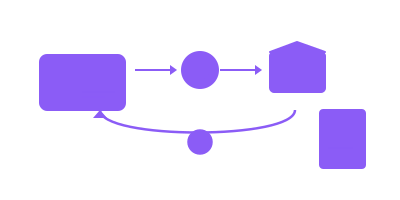
- A chargeback is your customer going to their bank instead of coming to you. The bank pulls the money out of your account first and asks you about it afterwards
- Find your response deadline before you do anything else. You get 20-45 days depending on the card network, and missing it means you lose automatically
- A $50 chargeback isn't a $50 problem. Add the fee and your time and it's roughly $95
- Three causes, three completely different responses: real fraud, your own mistake, and friendly fraud
- Fix your billing descriptor first. Free, takes 10 minutes, and it's the biggest single win most merchants have
- One chargeback is normal. A pattern is what costs you your ability to accept cards
A chargeback is when your customer goes to their bank instead of coming to you. They don't ask you for a refund. They call their bank, or tap a button in the banking app, and say the charge was wrong.
The money's already gone. Nobody's asking you to approve a refund. You're being told one already happened, and you've got a limited window to argue it back.
18 min readEvery business that takes cards gets chargebacks. One of them doesn't put you at risk, and it doesn't mean you did anything wrong. Two things matter: your deadline this week, and your pattern over the next six months.
Stripe, Square, and PayPal call these disputes in their dashboards. Traditional processors call them chargebacks. The card networks say dispute. They all mean the same event: your customer's bank reversed a charge and took your money.
What Actually Happens, Step by Step
Most explanations skip straight to reason codes and deadlines. Here's the whole sequence in order, in plain language.
-
Your customer contacts their bank. They say the charge was unauthorized, the item never showed up, or it arrived wrong. They don't have to contact you first, and most of them don't.
-
The bank takes the money back. Your customer usually gets credited right away. That's a provisional credit: temporary and reversible. Your side comes out of your account, or gets held back from your next payout. All of it happens before you've said a word.
-
You find out. Stripe emails you and files it under Payments > Disputes. Square puts it in Transactions > Disputes. PayPal buries it in the Resolution Center. Shopify Payments hangs it on the order itself: Orders > the order > Chargebacks. Wherever you're looking, it arrives with two things. A reason code, a short code for what your customer claimed. And a response deadline.
-
You decide: fight it or take the loss. Fighting it is called representment. You submit evidence that the sale was real and your customer got what they paid for.
-
Your customer's bank decides. The issuer reads your evidence. It either reverses the chargeback and you get the money, or upholds it and your customer keeps it.
-
Either side can escalate. Pre-arbitration, then arbitration. The card network rules on it and charges both sides for the privilege. It's rarely worth it below a few hundred dollars.
Start to finish, 60 to 120 days. It's slow, and your money sits somewhere else for most of it.
Miss the deadline and you lose automatically, no matter how good your case is. No review, no appeal. Go find your deadline before you read another word. Put it on your calendar, minus 3 days.
What a Chargeback Actually Costs
The sale amount is the smallest part of it.
| What you lose | Typical amount |
|---|---|
| The sale | Whatever the customer paid |
| The chargeback fee | $0 to $30, and several processors refund it if you win. Most charge $15. See the verified table |
| The product | Already shipped and gone in most cases |
| Your time | 30-60 minutes minimum to gather evidence and respond |
| Ratio damage | Every chargeback counts against you, and enough of them cost you your ability to accept cards at all |
A $50 chargeback isn't a $50 problem. It's $50 + a $15 fee + $20 of your time = roughly $85, plus the product if you shipped it.
Whether the fee sticks depends on who you're with. Helcim charges $0 if you win. Shopify Payments returns it. PayPal's standard tier doesn't charge it on a case decided in your favour. Square charges nothing either way. Stripe, Toast and PayPal's $20 card chargeback fee keep it win or lose.
Why Customers File Them
Nearly every chargeback lands in one of three buckets, and they need completely different responses.
1. Real fraud. Somebody used a stolen card. Your customer really didn't buy anything from you. You're probably losing this one, and that's fine. Your job is stopping the next one, not winning this one.
2. You made a mistake. Charged twice. Charged the wrong amount. Never got the item, or got something that didn't match the description. They may have tried to reach you and given up. Fix these at the root. They're entirely inside your control.
3. Friendly fraud. Your customer bought it, received it, and disputed anyway. Sometimes deliberate. More often it's someone who genuinely didn't recognize the charge. Or a family member who used the card. This is the biggest and fastest-growing category.
Customers dispute charges they don't recognize. Your billing descriptor is the text on their bank statement. If it's your LLC name instead of your store name, you're generating chargebacks against yourself. It's a 10-minute change in your processor dashboard, and it's the highest-return thing most merchants can do.
Stripe: Settings > Account Details > Statement descriptor. Square: Account & Settings > Business Information > Statement descriptor. Shopify Payments: Settings > Payments > Statement descriptor.
Can't find it? Call support and say: "I need my statement descriptor changed to my store name. What's the process, and when does it take effect?"
The Three Numbers That Matter
If you remember nothing else from this page, remember these.
| Number | What it is | Where you want to be |
|---|---|---|
| Your chargeback ratio | Chargebacks divided by total transactions, measured monthly | Under 0.5%. At 0.9% processors start paying attention. |
| Your response deadline | How long you have to submit evidence | 20-45 days depending on the card network. Miss it and you lose automatically. |
| Your win rate | How often your evidence works | 40-60% is achievable with good evidence. Under 20% means your evidence is weak or you're fighting the wrong cases. |
The ratio is the one that can end your business. A single chargeback is a cost of doing business. A pattern of them puts you in a network monitoring program with monthly fines. Then it gets your processing shut off.
What To Do Right Now
- Pull your last 20 disputes and sort them into the three buckets above: real fraud, your mistake, friendly fraud.
- Call 2 customers who disputed. Ask what actually happened.
- Set one rule: fight everything over $100, skip everything under $25. Check after 30 days whether that was right.
That's it. Optimization can wait.
Scale Callout
Advice built for a $10M business will waste your money at $50K. Find your row.
| Volume | Focus |
|---|---|
| Under $100K/mo | Your processor's built-in tools are fine. Fix your descriptor, make refunds easy to get, and respond to every dispute. Don't buy a chargeback prevention vendor yet. |
| $100K-$1M/mo | Alert services (Ethoca, Verifi CDRN) start paying for themselves. They cost roughly $20-40 per alert and save you the fee plus the ratio damage. |
| Over $1M/mo | You need a real representment process, in-house or outsourced. Alerts stop being optional. |
| Over $10M/mo | This is somebody's actual job. Look at guaranteed chargeback products for your highest-risk segments, and read those contracts closely. |
Exceed these and you land in a monitoring program with monthly fines.
- 1.5% + 1,500 combined fraud reports and disputes: Merchant Excessive (2.2% in CEMEA only)
- 0.5%: Non-compliant. The line you cross first, and an early warning rather than an automatic fee. Whether a per-dispute charge lands here depends on your acquirer's own portfolio status.
- The VAMP ratio counts TC40 fraud reports plus TC15 chargebacks
- 1.5% + 100/mo: ECM
- 3.0% + 300/mo: HECM
Your acquirer holds your merchant account. It can run tighter limits than the networks do, and it'll act on its own first. Email yours and ask: "What ratio are you measuring me on, what's your internal threshold, and am I in a monitoring program or warning period right now?" Get it in writing.
Response Deadlines
Miss these and you auto-lose.
| Action | Visa | Mastercard | Amex |
|---|---|---|---|
| Representment | 30 days | 45 days | 20 days |
| Pre-arbitration | 30 days | 30 days | No such stage |
| Arbitration | 45 days | 45 days | No such stage |
Amex runs neither stage. Its ladder is representment, then a re-dispute if the cardholder comes back with something new, then Amex decides. You get 20 days, and that's the only clock you have.
Every chargeback arrives with a reason code. The code tells you what your customer claimed, and it decides what evidence you need.
You can fight back. It's called representment: you submit evidence that the transaction was legitimate and your customer got what they paid for. Whether you win comes down almost entirely to the reason code.
- Fraud (10.4, 4837): 10-25% without 3DS, 50-70% with 3DS authentication
- Not received (13.1): 60-80% with tracking and delivery confirmation
- Cancelled recurring (13.2): 20-40% depending on your cancellation proof
- Digital goods: 20-35% with proper evidence collection (see CE 3.0)
Should I Fight This One?
This tree decides on reason code (what your customer claimed). For the dollar-amount version, see Refund Strategy. For 3DS liability, see Representment.
For dollar thresholds and worked examples by ticket size, see the Refund Strategy triage grid.
Prevention beats representment every time. A prevented chargeback saves the fee, the staff time, and the ratio damage all at once.
Talk To Your Customers
Before you optimize anything, call 5 customers who disputed. Ask fact-seeking questions, not opinion-seeking ones:
- "What were you trying to do when you made this purchase?"
- "What did you expect to see on your statement?"
- "What did you do when you first noticed the problem?"
- "Walk me through what happened after that."
Five conversations will teach you more than five hours of dashboard analysis. You'll find out fast whether you have a representment problem or a root cause problem.
MATCH/TMF: the blacklist that gets you permanently banned from processing
MATCH (Member Alert to Control High-Risk Merchants) is Mastercard's database of terminated merchants. Visa's shared equivalent is VMSS, the Visa Merchant Screening Service. Visa's TMF (Terminated Merchant File) is a separate thing, a file your acquirer keeps on you. Land on a shared list and getting card processing anywhere becomes extremely hard.
How you get listed
Mastercard publishes 11 reason codes. These are the ones SMBs actually hit:
| Reason Code | Description |
|---|---|
| 01 | Account data compromise, including Common Point of Purchase |
| 03 | Transaction laundering |
| 04 | Excessive chargebacks: over the previous three months, above 1.5% of your Mastercard sales, and USD 5,000 or more in chargebacks |
| 05 | Excessive fraud: 8% or more fraud-to-sales over three months, and 10 or more fraudulent transactions, and USD 5,000 or more |
| 06 | Coercion |
| 09 | Liquidation/insolvency |
| 10 | Violation of standards. No published number, which is why acquirers reach for it |
The ratio alone doesn't list you. Termination does. Once your acquirer terminates you while a code applies, adding you is mandatory within five calendar days.
What it means
- 5 years on the list, then automatic purge
- Most processors won't onboard you. They check MATCH before approval. Mastercard's rules do permit it, but appetite is another matter.
- Your principals are listed too, meaning owners and 25%+ shareholders
- It follows you to new businesses through name matching
Excessive chargebacks today can leave you unable to process payments for half a decade. There's a removal process. It doesn't need a lawyer. It does need your acquirer to agree the listing was an error. Prevention is still the only reliable answer.
→ See MATCH/TMF List for prevention, remediation, and what to do if you're already listed.
Where To Go Next
- Chargeback Lifecycle - the full dispute flow
- Consumer Rights (FCBA) - the law behind chargebacks
- Reason Codes - understand why
- Prevention Basics - stop them early
- Representment Guide - how to respond
- Compelling Evidence - what wins
- Time Frames - don't miss the deadline
- Zero Point Nine Panic - emergency
- Reduce Fast - 72-hour playbook
- Alert Services - deflection tools
The Guide, Pathway 2: Handling Your First Chargeback walks through the whole dispute process in three lessons, about 25 minutes.
See Also
- Chargeback Metrics - calculating your ratio
- Network Programs - VAMP and ECM details
- Fraud vs. Friendly Fraud - the classification that drives your response
- Friendly Fraud - first-party dispute abuse
- Risk Scoring - preventing fraud upstream
- Processor Management - working with processors
- Decline Codes - understanding auth declines
- Holds and Reserves - processor reserve impacts